The laws of hospitality
L ooking back at the programme of Symbiotic Hospitality so far, I keep returning to the way guesting and hosting are never stable positions.
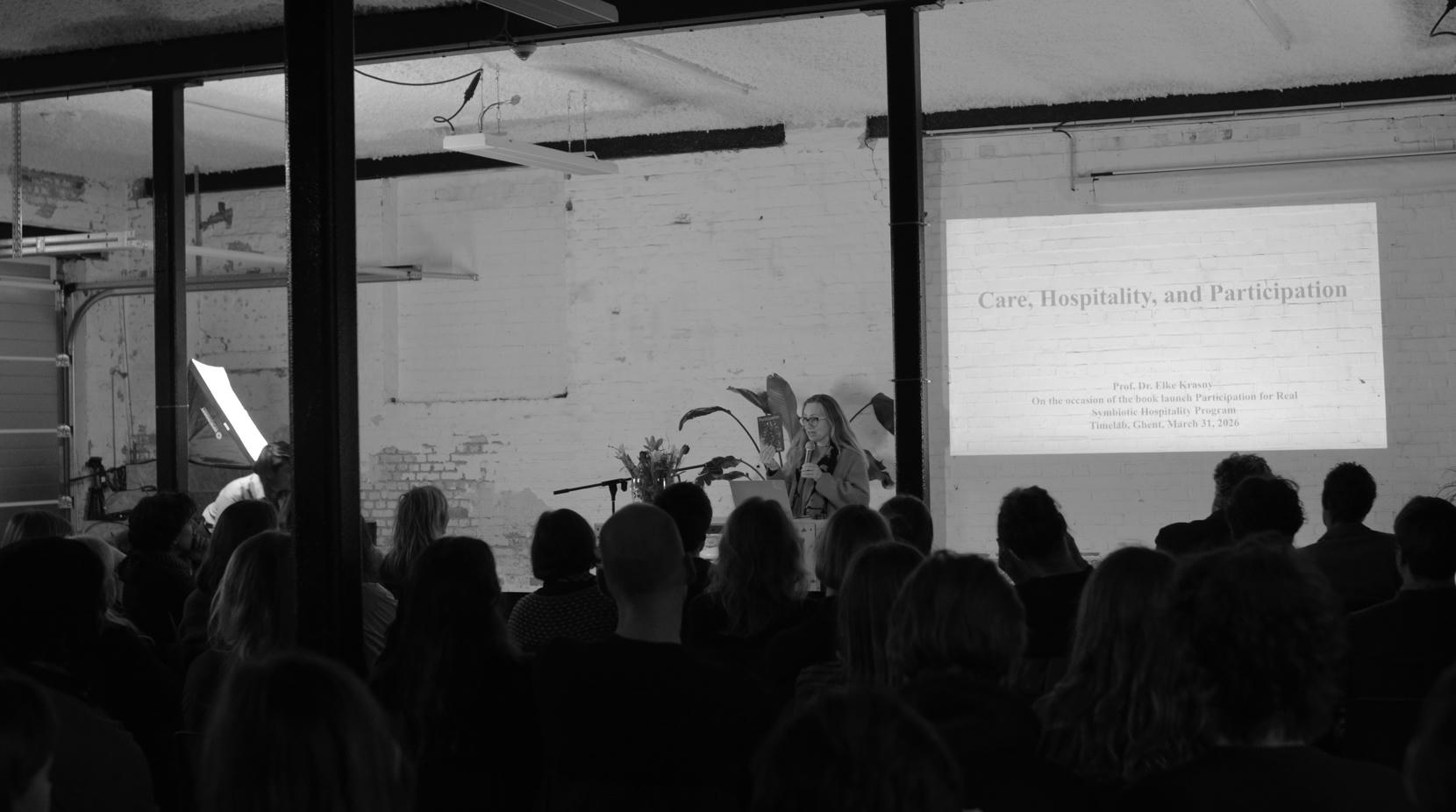
Being a host for the event of Hülya Ertaş and VAi for launching a book in which I was a guest author, participant, and dinner host at the same time came very close to what Francis, Kathy and Heidi are talking about in the manifesto. Guesting and hosting are actions and roles that can easily swap. They move into each other, overlap, and sometimes make it impossible to say exactly where one ends and the other begins.
These conditions made the preparation of Elke Krasny’s lecture different from the ones of Ally Pimor and Caitlin Walker. With Ally and Caitlin, I felt more directly how their lectures were connected to the programme of Symbiotic Hospitality. With Elke, it took me more effort to process that connection, from the simple fact VAi was the host of Elke’s presentation. The lecture stayed with me for longer, and in a deeper way, because it surprised me with strong intuitive reactions. Let me explain.
At a certain point Elke mentioned a quote by Derrida that kept me busy for days. I do not remember the exact words. What stayed with me was the distinction between unconditional hospitality and conditional hospitality, and the uneasiness it brought to me immediately. Am I a bad host when I have conditions in which I want my guests to behave?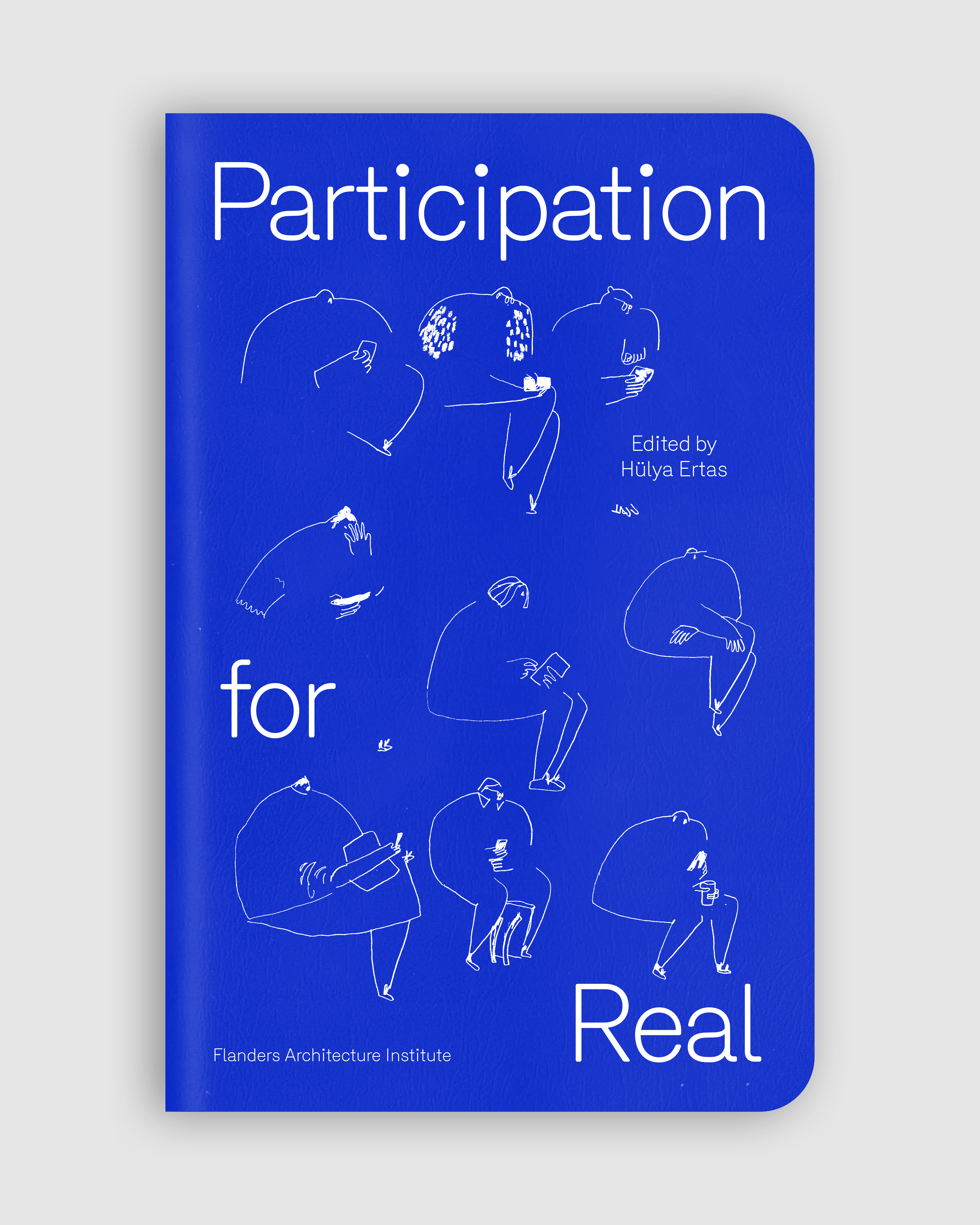
It brought me straight to the experience of being a host for the 40 heroes of our Time. Without discussing and setting boundaries to the invitation, this could never have happened. As a collective of makers who created a home, a space for being and working, we opened it up to a group of people in a way that touched a very extended form of hospitality. What I understood from the quote and from the lecture is that the power behind defining the conditions for hospitality also embodies exclusion, especially for groups who fall outside a predefined normative framework. The restrictions or selection that this brings goes against the law of hospitality.
How am I supposed to guard my boundaries as a host within the unconditionality of hosting? And how can hosting-guesting become symbiotic in these circumstances? Am I supposed to stretch my boundaries further for the sake of hospitality? And how does that influence my willingness to be a host? And how does that relate to the expectations connected to the fact that our organisation is working with the support of public money?
I felt the need to dive deeper into Derrida’s work to understand better the concept of unconditional hospitality. Of Hospitality, in which Anne Dufourmantelle invites Jacques Derrida to respond, a transcript of three lectures held in Paris in 1996, was one of the books I had selected for the bookshelves of the programme. It was easy to grab on a sunny Saturday morning, April 4, 2026, halfway the program.
The book starts with one of the most influential texts I read in my early twenties, after watching Julian Schoenaerts perform the Apology of Socrates in a tiny theatre somewhere in the east of the country. Plato describes, at the end of the fifth century before Christ, the words Socrates uses to address the citizens of Athens, who are deciding on his destiny after convicting him for his public conversations questioning the institution of power.
Socrates describes himself as a foreigner in court, not speaking the language of the law, and asks the jury to take this into account when judging him. This was read as arrogance. The trial ended with a small majority pleading him guilty, and Socrates drinking the poison that would bring his death.
But what did he mean by being a foreigner?
Derrida uses this figure, l’étranger venu de l’étranger, as a starting point for understanding the other at the border, in the initial surprise of contact with another, a stranger, a foreigner. Foreigners from different territories, speaking different languages, carrying different worldviews, are all reasons to call the other a foreigner.
Here the foreigner brings reflections and insights, new approaches and probably ways of doing and living, into an established territory. That makes the entry threatening for the established order.
Antigone guiding her father Oedipus across the border to die a foreigner’s death in an unknown place without a tomb also returns in Derrida’s text. Only Theseus may know the place of his final rest. She accepts his wish, which brings her into a position of impossible mourning and into the burden of keeping the life of her father unforgotten. She becomes the host and hostage of the truth of her father’s death.
How is this related to unconditional and conditional hospitality?
Derrida argues that the one cannot exist without the other. The unconditional, almost divine law of hospitality is impossible in reality. The conditional law should be seen as laws, in the plural, because they are constructed from what happened just before they were conducted. This is where the importance of space comes in. The laws of hospitality are connected to spatial and temporal conditions. The host is waiting at the threshold to welcome the guest. The foreigner enters the space of the master of the house and, by doing so, invites the host to inspect the laws that are installed there. It is a moment in time in which welcoming, insight, and a desire for knowledge of self are established. In this moment the host holds the laws towards the light of the law of unconditional hospitality. By enduring the questioning of the laws, the inevitable parasite or hostage role emerges.
“It is the one who invites, the inviting host, who becomes the hostage—and who really always has been. And the guest - the invited hostage, becomes the one who invites the one who invites, the master of the host. The guest becomes the host of the host. These substitutions make everyone into anyone else’s hostage. Such are the laws of hospitality. […] We enter from inside. The master of the house is at home, but nevertheless enters his home through the guest - who comes from outside. He enters his home by the grace of the visitor.” (p125)
This reminds me of the amazing experience of hosting Ally Pimor, who became the host of the evening on nature as a legal entity in organisations and institutions on March 12, 2026. She herself, being both guest and host, originating from a biracial family, seemed to understand the contradictory nature of the laws of hospitality and the almost divine being of the law of hospitality that we experience by being part of nature. Starting from comprehensible definitions of voicing nature in the constructions of human beings, she took us on a journey towards finding our inner nature, that universally connects to all and everything. She invited us to ground into our ancestral and spiritual beings, where a door opens to welcome ourselves as foreigners at the doorstep of the world we created.
What happens when the world houses the monster that invites you in, where the laws of hospitality are already questioned by your presence? Or when you master the room and the guest is questioning your laws?
Stepping in with curiosity and without judgement is one way in which clean language can help in becoming a guesting host and a hosting guest. Caitlin Walker took us on a two-day journey from rigid clean language to a more cleanish stance, giving agency to groups based on the differences of their mental beliefs. Self-empowered groups become their own guests and hosts in an ongoing process of self-exploration, in which a brave and safe environment can reveal itself.
And what happens when the space becomes hybrid?
What happens when the threshold between foreigner and master of the house, and equally between private and public space, becomes penetrated by public laws in private space?
Derrida describes the impact of technology as an interference in the boundaries of space, where imposed laws define the way people relate to each other. A private phone call or email can become public at any time, according to morals and laws. In this sense, the master of the house at any time may be the state and the law of the state, and one could ask to what extent there remains a “right to refuse” by the foreigner the laws of hospitality conducted at the home of the master or the monster.
Frederick van Amstel will take us along in questioning our agency to decide when we are willing to follow the laws of being a guided user of services, and when we decide otherwise.
Mathijs de Block and Massimiliano Simons will bring in the debate of genetic modification and hybrid species. First, Wendy Wuyts will guide us in writing through the voice of the Japanese knotweed, unwanted and dominant, a strong plant as a product of displacement. Mathijs will then guide us in genetically manipulating our writings by introducing some of the most common ways hybrid species come into being. Massimiliano will challenge us with ethical questions connected to our actions of manipulation.
The book reading of Past the Tower Under the Tree opens another line. Balamohan Shingade invites us to walk in the world of pedagogy outside of the school environment. By trying, falling and persisting, we learn. We learn to become productive citizens, but more important we learn to become hosts and guests of our own becoming. Through activism, solidarity, protest, strike, listening, walking along, and relational responsibility, his guest writers speak about precarious cultural work, the livelihood of the artist, and the myth that passion is enough. He describes a task and a tradition of never being neutral, where our laws of hospitality remain inseparable from the law of unconditional hospitality as an ideal.
Wim Cuyvers calls himself the janitor of his own place. A widespread rough landscape became a home for the homeless, for the unwanted guests of society. During a three-day visit to the land of Montavoix, we will become guests and hosts ourselves.
Looking back at Symbiotic Hospitality so far, I feel that the programme does not offer one answer to the question of what hospitality is. It keeps opening situations in which the roles of guest and host are exchanged, disturbed, and tested. It keeps asking how we live with boundaries, with institutions, with public responsibilities, with strangers, with nature, with technologies, with each other.
And maybe that is where the force of this programme lies: in keeping hospitality open as a question that has to be practised again and again, each time from within the concrete space, time, and laws in which we find ourselves