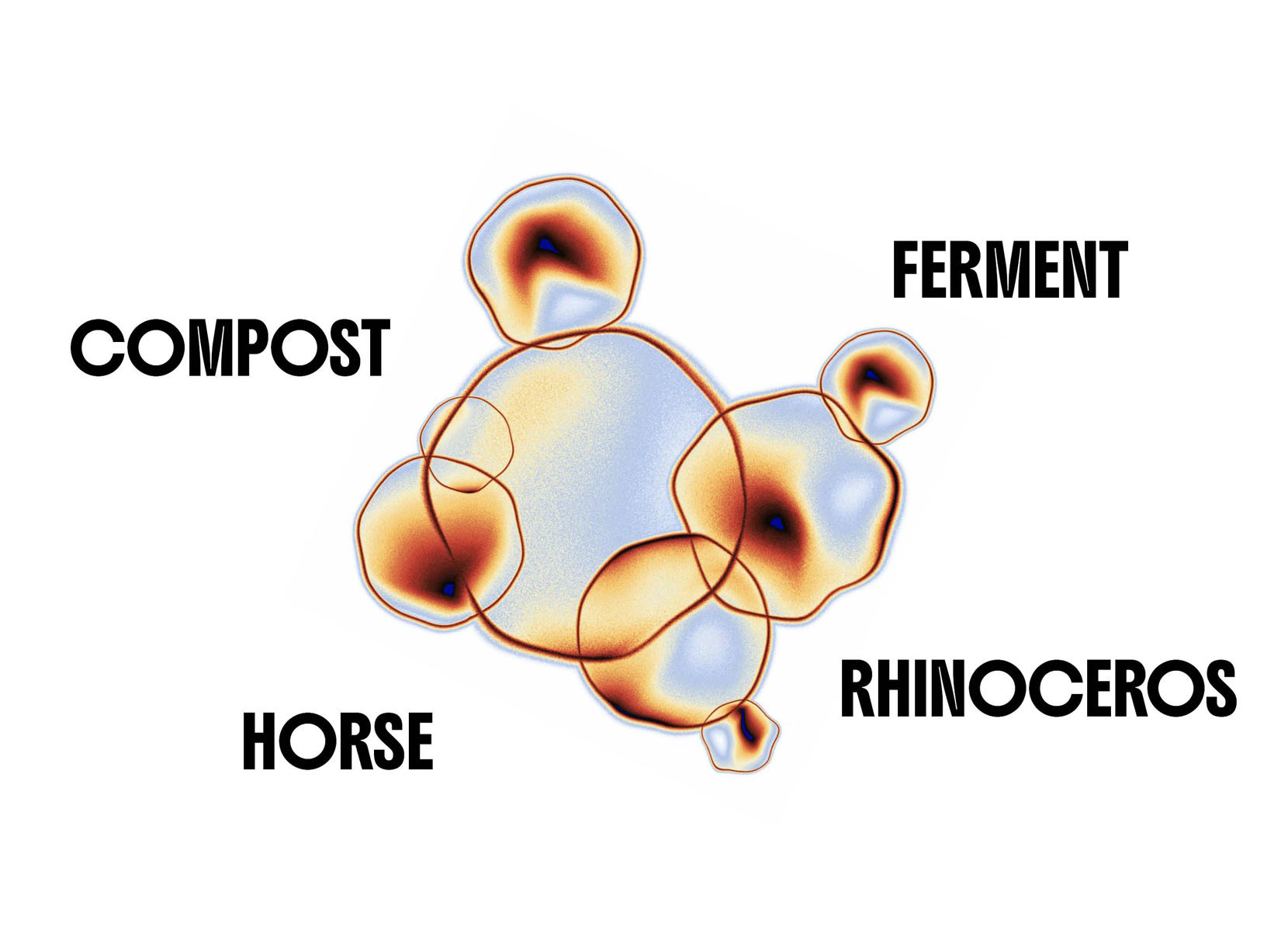
Making a new story of flourishing
|
|
|
Unsettling ideals of purity,
predictability, and control
|
|
|
Narrm, Melbourne
October 2025
|
|
|
|
|
If we take compost seriously (as I do) (1), how do we make it? How do we catalyse the biological conditions for decomposition and recomposition that feed flourishing ecosystems?
We start by casting our nets wide, sourcing carbon-rich ‘browns’ and nitrogen-rich ‘greens’ from our own specific physical and meta-physical locales. We build our compost piles carefully, layer by layer. As time passes we tend to them, turning the pile, making spaces for air to circulate, maintaining adequate moisture, cultivating the congenial conditions for our fungal and bacterial friends to do their important work - breaking down matter, raising temperatures, adding structure to soil, releasing energy and nutrients. We ensure the intermingling. We keep it porous, aerobic, generative, supportive of diverse lifeforms.
Composting takes our time and attention. A bodily pursuit, mobilising heat and energy (2), this matter matters, so we tend to it through observation, thinking and feeling.
As creative practitioners we similarly compose, make, prompt, cultivate and experiment with unexpected collaborations and combinations. We generate, feed, perform, reflect on, re-combine, provoke and curate the compost piles that we need to mobilise our collective heat and energy towards other possible worldings. And this describes how we can approach the opportunity of guest host <> host guest relations; it is through catalysing these unexpected combinations that we cultivate our collective expanded knowledge(s) and prompt an experiential orientation to place.
Sometimes we have called this action ‘situationing’ (3), a verb coined to describe our practice of bringing ‘strange bedfellows’ together and nurturing their unexpected offspringings. In situationing projects around our neighbourhood river, we have convened hybrid research collectives (4) of competitive rowers, junior sea scouts, ecological restoration volunteers, surf life savers, harbour masters, bird rescue teams, school kids, science curriculum experts, tourism operators, teachers, and local politicians, all cast together as experts in this place. With this, as with any invitation, we know there might be apprehension and tension. Acknowledging the mauri (lifeforce) of this place and the deep knowledge of and custodianship of this waterway by Mana Whenua (5), with full appreciation of shifting tides and estuarine flows, wind and sheltered spots, mangroves, mud, oysters, bird migrations, submerged rubbish and power pylons, we become attuned to the sensitive, almost-invisible and mostly un-articulated practices held in this place by each group.
Hosting this gathering through a kind of weak authorship, we tend to this and other situated compost piles, keeping things porous, aerobic, generative. We think through connection and inter-dependence (6), tuning in to exchanges of vital matter and energy, capable of ‘changing the story’.
[Kathy]
|
|
|
Dear Kathy, yesterday I was in conversation with a chef who had trained in Japan in the art of miso. He told me that in his training he learned not to rely on a single miso, but to combine misos from different regions, since it is precisely this mixture that produces depth and complexity. That stayed with me as I was reading your message.
It made me wonder if fermentation might sit alongside compost as another metaphor for guest–host relations. Compost emphasizes decomposition, mixture and renewal over time. Fermentation, by contrast, highlights invisible and uncontrollable actors: microbes, humidity, temperature, the specificity of context. It foregrounds a certain humility: we humans can prepare and host the conditions, but we never fully control what happens.
This connects back to the guest-host dynamic: fermentation is hosting the microbial other, while also being hosted by it in return. As a host in Timelab this manifests itself in ‘holding space’ (7). As a host I experience this as a certain kind of giving, and a certain kind of giving-up. The giving is “a steady rhythm” and “recurring habit(s)”, what is given up is the guarantee, or the service that is provided to produce a guarantee. When we hold space we have no guarantee on direction, result or harmony. We give our attention to tensions and temporary shifts. We don’t neutralise, but make visible what is implicitly present. This does not mean there are no boundaries to what is possible. Holding space asks for a kind of integrity that is aware of the strength of the structures that carry us (8).
When we host our space, the space does not act as a mere background. We facilitate space and time for situated knowledge to emerge, without taking the ownership or directing of the knowledge that arises. This act of hosting gives meaning to the shared space apart from visible structures.
Space is therefore never neutral. It is drenched with meaning created over time and many relationships that influenced the appearance it has today. What does being a host mean for sharing this space? What does it mean in terms of accessibility and flexibility of infrastructure that is privately owned?
What kind of action does it enable or not? What powerdynamics does it install? How does memory speak? Is there a symbolic meaning to being an arts space? And how do people read the space and their belonging to it?
Building a conscious perceptual experience of our space allows us to negotiate the meaning of its signs (9). How do we, as a host, mediate this space in consideration of multiple levels of representation and can we, in this process, step away from abelism as a norm (10)?
Fermentation unsettles ideals of purity, predictability, and control. It needs time and feeding to generate life. What might appear as excess, deviation, or instability is often what generates vitality, richness and transformation. In that sense, fermentation, like guest-host relationships, is a conscious practice of relations and structures, never free of meaning.
[Evi]
|
|
|
Redefining cultural space
|
|
|
Hosting guests and
guesting hosts
|
|
|
This brings me to an earlier experience as a guest during an artist research residency (11) in Japan. The questions I wanted to research at that time concerned the meaning of the collective- or assembly, and how to practice a form of agency, within and outside a cultural space. Or in other words, how to create openings within a dominant social, cultural and economic system (society) to do things, as well as relate, otherwise.
In the autumn of 2023, I was a guest for six weeks at Toshunji, a temple in the tradition of Rinzai Buddhism in Yamaguchi city. Between observing as well as engaging with the daily practices of za-zen (meditation), and chores, such as clearing the adjacent bamboo forest making it into a paddock–the temple had agreed to take care of an elderly horse, I interviewed Mr. Fukano, head-monk, to learn about his vision and ideas on how to serve the local community. It was already clear things go a little different at Toshunji. A vegetable garden was prominently placed in front of the temple, instead of in the backyard. Almost every week the temple facilitates concerts or traditional theater performances, as well as a small film club. “The temple is constantly in a state of becoming in relation to its inhabitants—the monks—and the needs and requests of the local community,” Mr. Fukano explained. What struck me in these conversations is the effortless peeling away of the traditional frameworks of what a temple is generally understood to be. Placing a garden in front of the temple for example, is a radical break with its traditional composed appearance- which also provoked criticism of locals and colleagues at times. And the arrival of the horse didn't go without stress amongst the monks, who dreaded the responsibility, the pressure, and their capacity to take on such a task. These situations, nonetheless, were often riddled with a (dry) sense of humour. From the perspective of Zen Buddhism, you don't define what is happening in the moment: by letting go of form, you allow a situation to extend into the future. “It's about a continuous building of capacity for diversity, for that what is different” Mr. Fukano elaborated.
Placing an extra plate on the table, washing dishes together, searching for words through gestures, I became aware that accepting my presence within the intimacy of their community was part of this practice. At the same time, it reminded me of what an artist-in-residency actually entails for artists: In questioning, tasting, feeling, looking, getting lost or confused- when all senses are at work, allows for being actively present. Hence the narrative unfolds in unexpected and surprising, meaningful ways.
[Heidi]
|
|
|
How much I love Heidi’s observation that “you don't define what is happening in the moment: by letting go of form, you allow a situation to extend into the future”.
There is a text in the Pali canon called the Khaggavissanasutta, which means the Mellifluous Sayings [sounding like] the Horn on the Head of Rhinoceros (12). I have studied this sutra until knowing it by heart, in the days that I was an apprentice monk in the hermitage of Buduruvagala in Sri Lanka. The general idea is that life is a rhinoceros, moving about in the jungle of Samsara, altogether unpredictably, and all we can do is be like the horn on its head. Where we are alone and steadfast, glued to the animal’s nose, we live in the illusion of stability, silently missing out on the perspective we need to grasp the reality of the heavyweight beast moving through overgrown paths underneath us. We cannot define what is happening - while we surmise that we are in control.
Likewise is hosting, which exists glued to the head of an animal called guesting. Life is symbiosis. Hosts and guests are like brackets, parentheses, defining their essence like clay defines the space inside the pot held by the potter’s hands. Hosting and guesting are grains of sand and lime and compost and droplets and atomic substances moving in Brownian motion and shaping the existential soup given taste by Heidi’s temple vegetable garden. Hosting and guesting are the main principles of a symbiotic system, self-designed and self-organized on the premise of mutual benefits, where every atom of the constellation is not just a selfish gene, but also an altruist one.
Hosting guests and guesting hosts entails the performance of a bio-dance, a never-stopping eco-choreography, a teaching of dance as if the world matters (13) Meanwhile I follow a hitherto unknown track in the tropical forest, my feet decomposing into water with the wetness of my body and mind; I live with the lichen and mosses and ferns and insects and snakes and vines and figs that share space on the tree trunks keeping the crowns of the trees afloat in the air, like the horn on the head of rhinoceros. In the in-between, composed by compost and other posts, “it is about a continuous building capacity for diversity, for what is different (14)."
[Francis]
|
|
|
|
|
Footnotes
1.
In “Staying With the Trouble”, Haraway suggests that to "change the story" we “require each other in unexpected collaborations and combinations, in hot compost piles” (p. 4). Through prompting and staying with generative though sometimes difficult conditions we might become “attuned to still possible finite flourishing, still possible recuperation” (p. 10) of our troubled worlds. In this short text I am testing Haraway's metaphor in relation to our practice HOOPLA, but to note, as gardeners HOOPLA also take literal compost seriously. Haraway, Donna Jeanne. Staying With the Trouble: Making Kin in the Chthulucene, 2016.
2.
Jane Bennett proposes an ‘alter-narrative of enchantment’ as a means of generating attachment to the world. Such re-orientation requires “bodily movements in space, mobilisations of heat and energy, a series of choreographed gestures and a distinctive assemblage of affective propulsions” (p. 3). Bennett, Jane. The Enchantment of Modern Life: Attachments, Crossings, and Ethics. Princeton University Press, 2001.
3.
For a full discussion of the situationing tactic see Waghorn, Kathy, The practice of feeling for place: a compendium for an expanded Architecture. PhD Thesis, RMIT, Melbourne, 2017. https://doi.org/10.25439/rmt.27599400
4.
A term borrowed from Callon & Rabeharisoa, Research “in the wild” and the shaping of new social identities. Technology in Society, 193–204, 2003
5.
Mana Whenua are the Māori indigenous people of Aotearoa New Zealand who hold territorial rights and jurisdiction over certain land or territory, power associated with possession and occupation of tribal land. The tribe's history and legends are based in the lands they have occupied over generations and the land provides the sustenance for the people and for the hospitality of guests. This definition is sourced from Moorfield, J. C. (n.d.). Te aka Māori dictionary. maoridictionary.co.nz.
6.
This invocation for thinking connection and interdependence comes from the 'piecing together’ approach described by the feminist economists J.K. Gibson-Graham. In their advocacy for crafting an experimental position they sense the importance of “thinking connection, convening wider publics and enrolling lively matter in the ‘hybrid research collectives’ that we hope will emerge” (p. 5). Gibson-Graham, J. K., 2011. A Feminist Project of Belonging for the Anthropocene. Gender, Place and Culture: A Journal of Feminist Geography, 18, 1–21.
7.
Moore, C., Coughlan, D., & Scharmer, O. The Art of Hosting: Participatory Leadership Practices. (Art of Hosting Community of Practice handbook), 2015
8.
Just-city.org
9.
https://leavingevidence.wordpress.com/2011/05/05/access-intimacy-the-missing-link/
10.
Lewis, T. A. Working definition of ableism, 2019
11.
Do-a-front residency, an initiative by architect Ayako Kurata, connects artists with local communities in Yamaguchi city, Japan
12.
This text is in the Uragavagga section of the Suttanipata (GRETIL 2020, Göttingen Register of Electronic Texts in Indian Languages, https://gretil.sub.uni-goettingen.de/), a series of early discourses of the historical Buddha often cited and learned by rote in Theravada Buddhist communities. The text is somewhat controversial: nobody really seems to be sure how to interpret the horn-of-the-rhinoceros metaphor. I like this ambiguity.
13.
Alison East, 2011
14.
Mr. Fukano, head monk, Toshunji, Yamaguchi, Japan
|
|
|
|
|